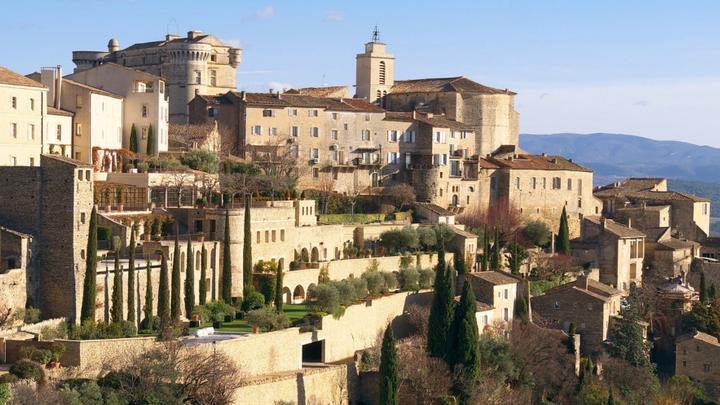
Stone doesn’t age; it develops a beautiful patina
Traditional Luberon buildings are constructed from local limestone, with walls that can be as thick as 80 cm. This isn’t just an aesthetic choice: it’s a time-honoured building technique that naturally regulates temperature, resists moisture, and withstands the centuries without structural deterioration.
A blockwork wall coated in render, on the other hand, has a far shorter lifespan. Exterior insulation deteriorates, PVC joinery yellows, and finishes crack. Modern homes are designed to be efficient at the point of delivery, but often far less so twenty years later…
And what about new-build stone properties? An important distinction
There are indeed recent constructions today, particularly around Gordes and in certain Luberon villages, that incorporate a local stone lining and adopt Provençal architectural codes. The effort is genuine, and the result can be appealing.
But a closer look is essential. Behind the stone façade, you’ll almost always find contemporary construction materials : aluminium window frames, synthetic insulation, concrete slabs, and standardised finishes. The character is there on the surface; the soul, however, is acquired differently. These properties have their merits, offering modern technical features and strong energy performance, but they lack the same long-term value trajectory as an authentic farmhouse.
Natural materials age well; synthetic ones do not
In a restored old farmhouse, you’ll find terracotta floor tiles that grow more beautiful with age, exposed timber beams in solid wood that improve over time, and solid timber shutters that last generations with minimal maintenance. These materials possess an inherent longevity that substitutes like laminate flooring, acrylic renders, or mixed joinery will never match.
It’s also a matter of deferred cost: renovating an old building can be expensive upfront, but the interventions are carried out on noble, durable materials. Repairing or replacing elements in a recent build often costs just as much—and generates far more limited added value.
Heritage value: the old resists market cycles
In the Luberon property market, high-quality older homes barely lose value. A beautifully restored farmhouse in Ménerbes or a stone bastide in Bonnieux is a rare asset—there won’t be another like it. This scarcity is a safeguard against depreciation.
By contrast, a new-build property in a peripheral location is immediately in competition with newer developments that follow it. Its relative value diminishes mechanically over time and with each new wave of completions.
The luxury market makes this clear: affluent buyers, particularly international ones, almost exclusively seek authentic old properties. Modern construction, even when clad in stone, doesn’t satisfy them.
The renovated old: the best of both worlds
This is where the true opportunityoften lies. Old farmhouses were designed for rural life: low, functional, fragmented spaces. But their robust structure can be transformed entirely. Removing a partition, opening up a volume beneath the roof, creating a bright master suite, fitting a contemporary kitchen into 80 cm-thick walls—all of this is possible, and it’s precisely what the finest renovation projects in the Luberon have in common.
You can commission bespoke joinery, select noble materials for every finish, and achieve all the comfort of a modern home within a shell that’s two centuries old. Something new-build construction, no matter how well dressed, can never offer.
What this means for your purchase
If you’re looking for a property in the Luberon, the old isn’t just more beautiful—it’s sturdier, rarer, and more resilient over time. It’s a heritage choice as much as a lifestyle one.
The key is knowing how to read an old property: spotting fine structure beneath a shoddy renovation, uncovering hidden potential, and avoiding nasty surprises. This is precisely where local expertise makes all the difference.
A project in mind?
Marie BEAUCOURT
Estate Agent & Founder
06 52 98 85 17